




ORGANS OF PARIS © 2026 Vincent Hildebrandt HOME ALL ORGANS
Versailles
Chateau
1 Place Léon Gambetta, 78000 VersaillesCabinet de Mme Adelaïde
(Dauphin’s organ)
Chapelle royal>
Château de Versailles Spectacles >



E6
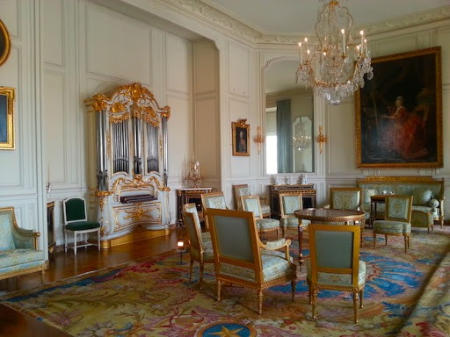
The so-called "Dauphin's organ" in Madame Adélaïde's
large drawing room is said to have been made for a royal
family member, but who exactly is still unclear. It was
placed in this room to recall how Louis XV's kids loved
music.
The organ was likely one of three cabinet organs ordered
from builder Nicolas Sommer in 1747 for the Dauphin,
the Dauphine, and Madame Adélaïde.
Back then, the instrument had two manuals, 8 stops, and
a one-octave French pedalboard.
After the Dauphin's death, the organ moved to Saint-
Louis church in Versailles (now the cathedral). In 1771,
King Louis XVI had it installed at the Petit Trianon for
Marie-Antoinette of Austria.
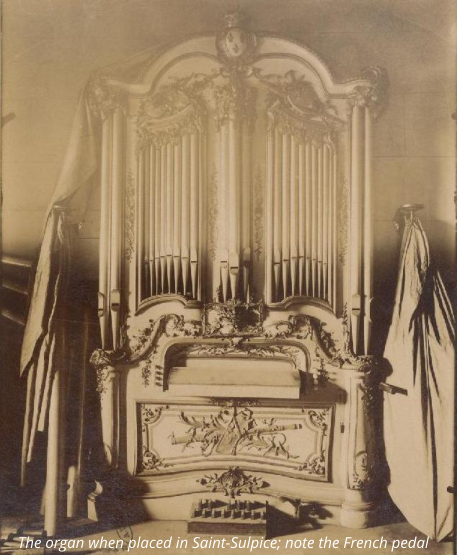
The priest at Saint-Sulpice in Paris bought the instrument
to serve as a choir organ for Pope Pius VII's visit. It got
repaired, with a missing stop replaced by a new reed, and
the damaged console rebuilt. It was placed in the Virgin's
chapel.
In 1863, Cavaillé-Coll modified it and moved it to Saint-
Sulpice's student chapel (then the catechism chapel).
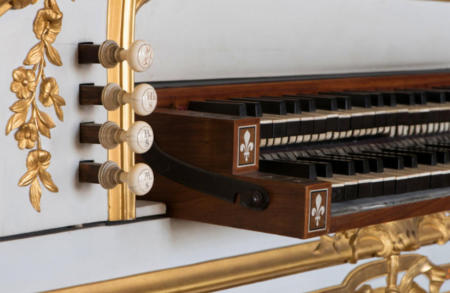
In 1896, Cavaillé-Coll replaced the manuals with the
historic ones from the royal chapel's great organ at
Versailles castle, after organist Charles-Marie Widor
pushed for it. Widor paid to rebuild and install royal
ornaments lost in the Revolution.
In 1897, Cavaillé-Coll swapped the 8' Clarinet for a 2 2/3'
Nazard.
After that date, they fitted a new wind supply in the base
of the case while adding a Cornet to the Swell—they
removed the Oboe, cut down the 8' Flute to make it a 4',
and added Quint, Fourth, and Tierce on the Oboe slide.
They kept the all-wood 8' Bourdon, whose construction is
similar to Daublaine & Callinet's style.
In 1968, the organ was moved from Saint-Sulpice to the
Dauphine's grand cabinet at Versailles castle.
In 1980, Gonzalez restored the organ and moved it to
Madame Adélaïde's grand salon.
In 2024, a call went out for this organ's restoration.
The windchests and action are by Cavaillé-Coll. The pipes
come from Cavaillé-Coll and Danion-Gonzalez.



1747 - Nicolas Sommer (1)
1863/1896 - Aristide Cavaillé-Coll (6)
1980 - Victor Gonzalez (6)
II/8- mechanical traction
Composition








Organs of Paris


Versailles
Chateau
1 Place Léon Gambetta, 78000 VersaillesCabinet de Mme Adelaïde
(Dauphin’s organ)
Chapelle royal>
Château de Versailles Spectacles >
ORGANS OF PARIS © 2026 Vincent Hildebrandt

E6
The so-called "Dauphin's organ" in Madame Adélaïde's large
drawing room is said to have been made for a royal family
member, but who exactly is still unclear. It was placed in this
room to recall how Louis XV's kids loved music.
The organ was likely one of three cabinet organs ordered
from builder Nicolas Sommer in 1747 for the Dauphin, the
Dauphine, and Madame Adélaïde.
Back then, the instrument had two manuals, 8 stops, and a
one-octave French pedalboard.
After the Dauphin's death, the organ moved to Saint-Louis
church in Versailles (now the cathedral). In 1771, King Louis
XVI had it installed at the Petit Trianon for Marie-Antoinette
of Austria.
The priest at Saint-Sulpice in Paris bought the instrument to
serve as a choir organ for Pope Pius VII's visit. It got repaired,
with a missing stop replaced by a new reed, and the
damaged console rebuilt. It was placed in the Virgin's chapel.
In 1863, Cavaillé-Coll modified it and moved it to Saint-
Sulpice's student chapel (then the catechism chapel).
In 1896, Cavaillé-Coll replaced the manuals with the historic
ones from the royal chapel's great organ at Versailles castle,
after organist Charles-Marie Widor pushed for it. Widor paid
to rebuild and install royal ornaments lost in the Revolution.
In 1897, Cavaillé-Coll swapped the 8' Clarinet for a 2 2/3'
Nazard.
After that date, they fitted a new wind supply in the base of
the case while adding a Cornet to the Swell—they removed
the Oboe, cut down the 8' Flute to make it a 4', and added
Quint, Fourth, and Tierce on the Oboe slide. They kept the
all-wood 8' Bourdon, whose construction is similar to
Daublaine & Callinet's style.
In 1968, the organ was moved from Saint-Sulpice to the
Dauphine's grand cabinet at Versailles castle.
In 1980, Gonzalez restored the organ and moved it to
Madame Adélaïde's grand salon.
In 2024, a call went out for this organ's restoration.
The windchests and action are by Cavaillé-Coll. The pipes come
from Cavaillé-Coll and Danion-Gonzalez.
1747 - Nicolas Sommer (1)
1863/1896 - Aristide Cavaillé-Coll (6)
1980 - Victor Gonzalez (6)
II/8- mechanical traction
Composition